The Albert lab studies how genomic variation influences gene expression and complex traits.
Each individual in a species carries their own, unique genome. These genomes differ from each other at thousands to millions of sites. Many of these differences have no effect. Others can dramatically influence the way an individual looks, how it behaves, or which diseases it is susceptible to. How can we tell which DNA differences have consequences for the organism? How exactly do these polymorphisms exert their effects? And how did this genomic diversity evolve?
We are examining these questions by combining experimental functional genomics and computational statistical genetics. A particular focus is on emerging technologies for high-throughput reading, editing, and synthesizing of genomes, which now allow us to systematically answer questions at the core of genetics. We deploy these tools in yeast and other species to learn fundamental principles of how genetic variation shapes phenotypes across eukaryotic life.
Genetics of gene expression variation in yeast
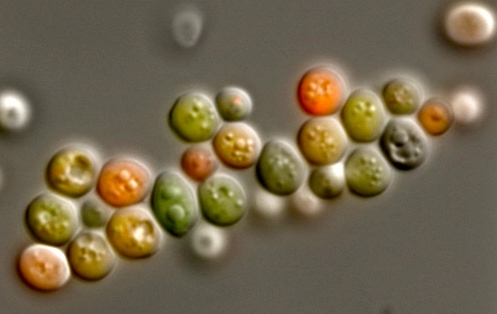 Many genetic variants influence an organism by changing how much a certain gene is expressed (reviewed here). Such “regulatory variants” are responsible for most of the genetic risk for many common human diseases. Many fundamental questions about regulatory variation remain unsolved. What are the individual DNA mutations that cause expression change? When a variant influences mRNA levels, does it also influence protein levels? What are the consequences of genetically altered gene expression on the organism? We are tackling these questions in the yeast Saccharomyces cerevisae, an ideal organism for examining basic principles of how regulatory variation operates.
We develop novel genome editing strategies to dissect causal genes and DNA variants that influence gene expression and complex traits. For example, we have revealed considerable complexity in causal variants that alter gene expression via trans-acting mechanisms, showing that these variants reside in genes that perform a wide variety of functions and that can even harbor multiple causal variants. We also used massively-parallel reporter assays to identify hundreds of causal variants in yeast promoters, studied their characteristics, and worked towards predicting them from genome sequence.
A long-running focus of our work is how genetic differences influence protein as opposed to mRNA levels. Using methods that leverage millions of individual yeast cells in a single experiment, we have shown that genetic influences on protein expression are highly complex. Dozens of regions in the genome can influence the expression of a single gene. Studying these interleaved regulatory relationships is a major focus of the lab.
For example, genetic effects on mRNA levels are often quite different from those on the protein levels of the same genes. How this happens remains a fundamentally open question. To address this, we are studying genetic influences on protein degradation as a major source of mRNA/protein discrepancies and have recently revealed a striking amount of genetic variation in the deeply conserved ubiquitin-proteasome system, the cell’s primary protein degradation system.
A major area of our current and ongoing work connects information on organismal traits with our expertise on regulatory variation to understand the biological mechanisms through which DNA variation affects complex traits.
The lab also works on regulatory variation beyond yeast. For example, together with our collaborators, we have examined causes and consequences of regulatory variation in human milk and are using high-throughput experimental systems to identify causal regulatory variants that contribute to human behavior.
 The Albert Lab